


Why Your AI Teammate is Failing
If you’ve been disappointed by AI at work, you might be blaming the wrong thing.
Imagine hiring a brilliant new teammate. They have an MBA, deep industry experience, and a track record of success. On day one, you ask them to draft a company strategy.
But there’s a catch. You don’t give them access to internal documents. You don’t invite them to key meetings. You don’t show them past decisions, customer feedback, or product plans.
When the output falls flat, you conclude the problem is that they aren’t very smart.
This sounds absurd when applied to a human, yet this is exactly how many organizations judge AI effectiveness today. And it’s not super productive.
In my role as a product leader working on Confluence at Atlassian, I spend a lot of time thinking about how knowledge is created, shared, and reused inside organizations. Recently, that work has converged with a critical industry shift: the intersection of organizational knowledge and AI.
Looking across how teams are adopting AI, a consistent pattern keeps emerging. Organizations expect AI to behave like a fully ramped teammate capable of reasoning, planning, and offering meaningful insight. When the results fall short, the default explanation is that the feature isn’t good enough or the underlying model isn’t smart enough.
What rarely gets questioned is a more fundamental factor:
Has the AI been given the context it needs to do good work?
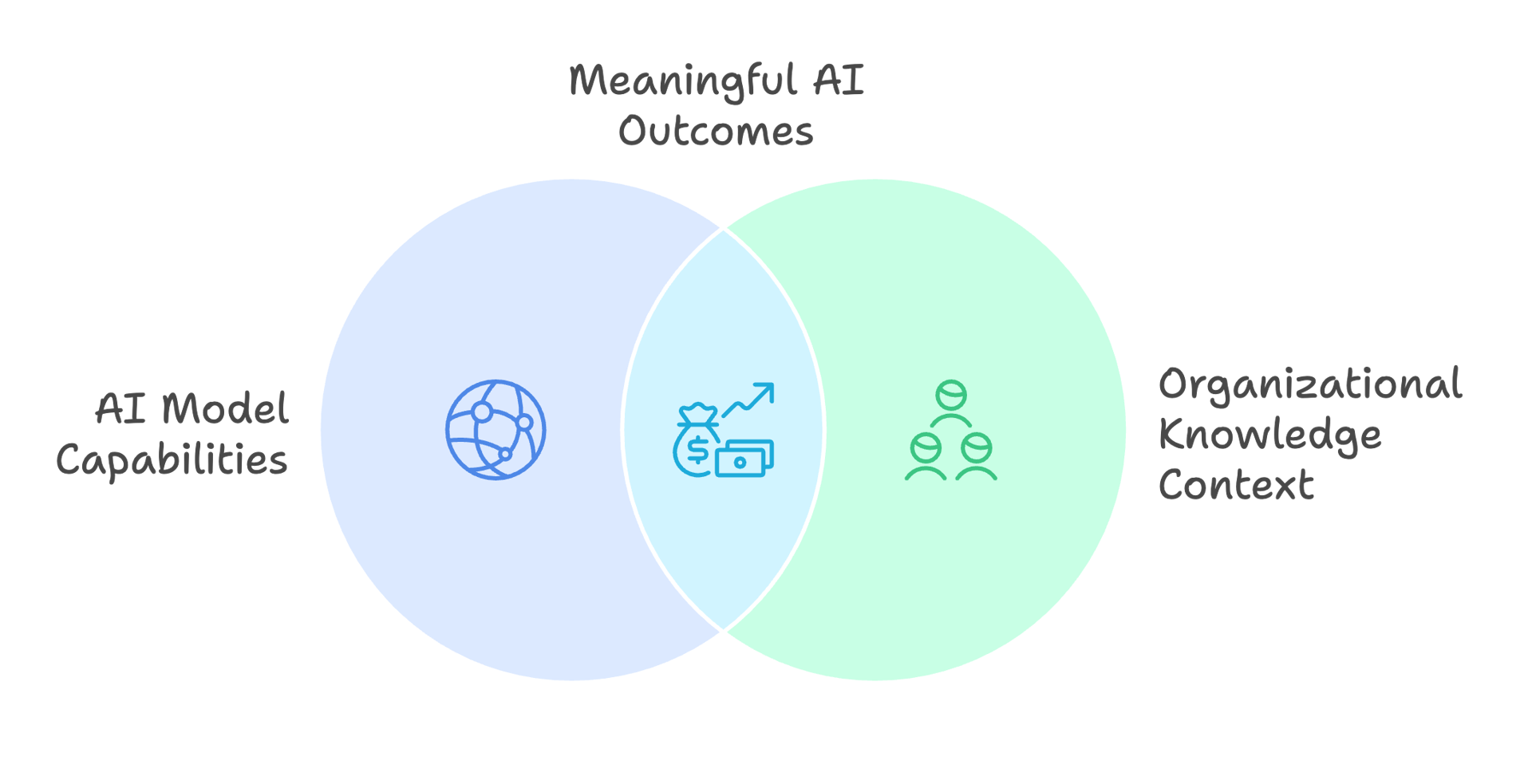
AI regularly fails because it doesn’t know enough about the environment it’s operating in. Without an aggregated view of organizational knowledge that the AI can draw from (a system of record for knowledge), it is forced to operate with a partial, fragmented view of the world.
The Real Promise of AI at Work
The promise of AI is to provide organizations with an infinitely scalable number of world-class, digital teammates.
We aren’t just talking about a faster spell-checker or a summarizer. We are talking about AI that functions like a real individual contributor. Someone who understands the business, knows how work gets done, remembers past decisions, and can move work forward without being re-briefed every single time.
That vision is compelling. It’s the future we are all building toward. But getting there requires confronting a much more foundational problem than model quality.
Context, Not Intelligence, Determines Effectiveness
To understand why context is the bottleneck, we have to distinguish between capability and knowledge.
A teammate’s raw intelligence doesn’t change much during their first 90 days. But their effectiveness skyrockets. Why? Because they stop guessing and start navigating. They learn the unwritten rules, the history of specific decisions, and the “why” behind the “what.”
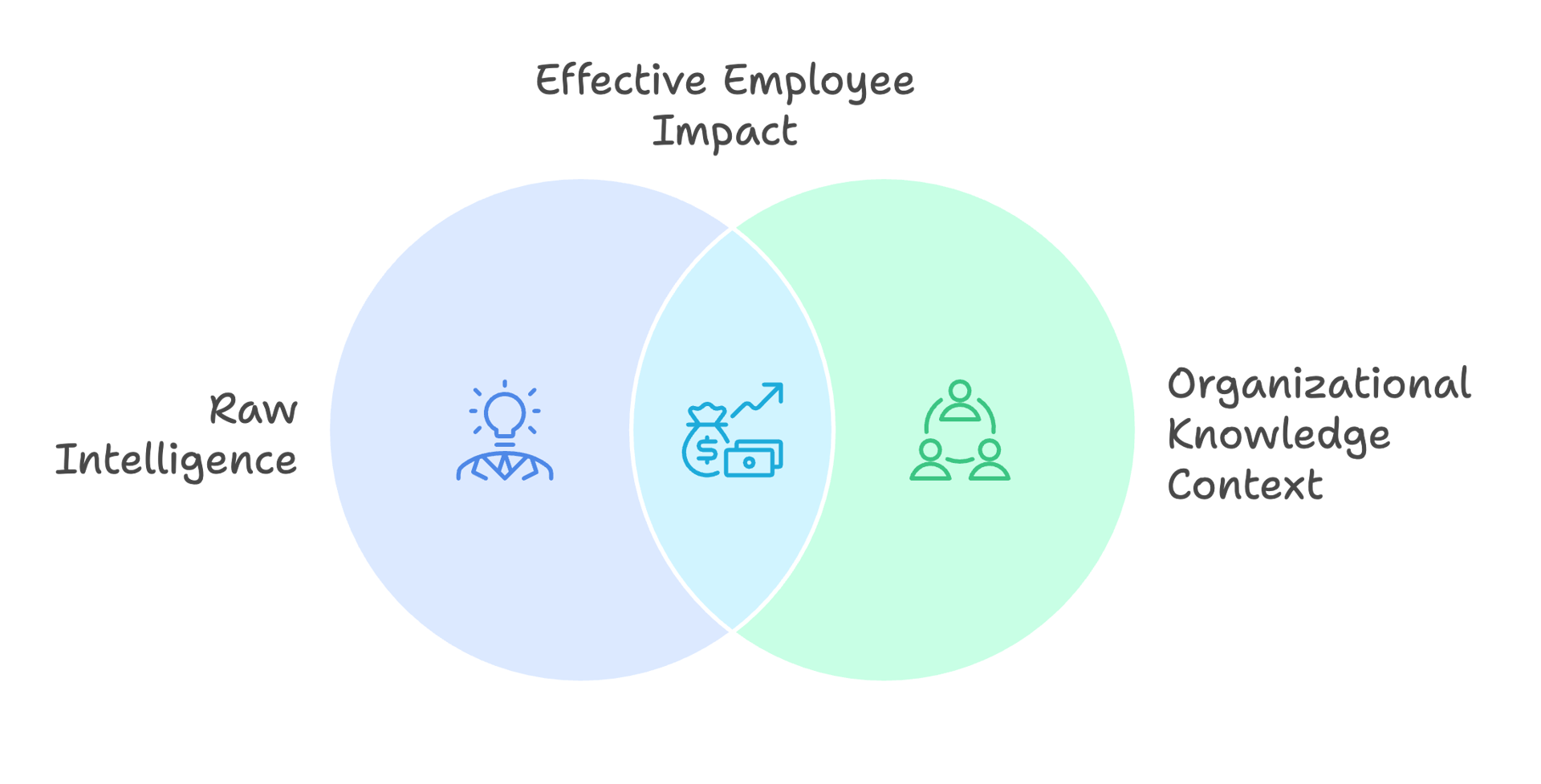
We need to apply this same logic to AI. We are often obsessed with the model’s IQ (its ability to reason) while neglecting its memory. If you hand a genius a blank sheet of paper and ask for a strategy, you get generic fluff. If you hand an average strategist a dossier of customer interviews and past experiments, you get a plan.
AI works the same way.
It can only reason over the context it has access to. When that context is fragmented, outdated, or missing, the outputs look exactly like what many teams see today. Generic answers. Shallow recommendations. Strategies that don’t quite fit reality.
These disappointing results are often blamed on the model (”GPT-x isn’t ready yet”) or the feature (”This chatbot is useless”), but the real issue is usually upstream.
For AI to function like a teammate rather than a novelty, it needs a consolidated, curated view of organizational knowledge. It needs a system of record to reliably draw from. Without that foundation, even highly capable models will struggle to deliver meaningful value.
The Challenge of Data Silos
Once you accept that AI needs the same access to context as a real teammate, the next question becomes how to actually make that happen.
The reality is that teams are always going to work across a wide range of tools from different providers.
Documents live in one place.
Conversations happen in another.
Projects are tracked in a third.
Designs live in a fourth.
Decisions are often scattered across all of them. This is simply how modern work happens. The challenge for organizations is not to fight this reality, but to confront it.
If work is distributed, then knowledge will be too. Unless there is a deliberate effort to aggregate it. AI inherently provides better outcomes when the context you provide is contained and bounded.
Think about it this way:
If you ask an employee to answer a question, but you tell them they have to search every nook and cranny of your massive headquarters to find the answer, they will likely fail.
But if you tell them to go to the dedicated project room on the first floor, they will succeed.
The tighter the area they need to search, and the more consolidated the context they need to use, the easier it’ll be for them to get you what you’re looking for. We need to build the project room.
To give AI the context it needs, organizations have to put the right processes and practices in place to centrally aggregate and curate knowledge that lives across tools. It requires intentionally creating a system of record that pulls together what matters, adds structure and trust, and gives AI a consolidated view of the organization it is meant to support.
3 Steps to Build a System of Record for AI
These principles aren’t specific to any one stack. Every organization can implement them differently depending on its tools, scale, and constraints.
Building a system of record for knowledge requires deliberate choices about how context is made available, how work is structured, and how knowledge is continuously created and maintained. Below are three principles that apply regardless of the tools you use, followed by how we approach them at Atlassian.
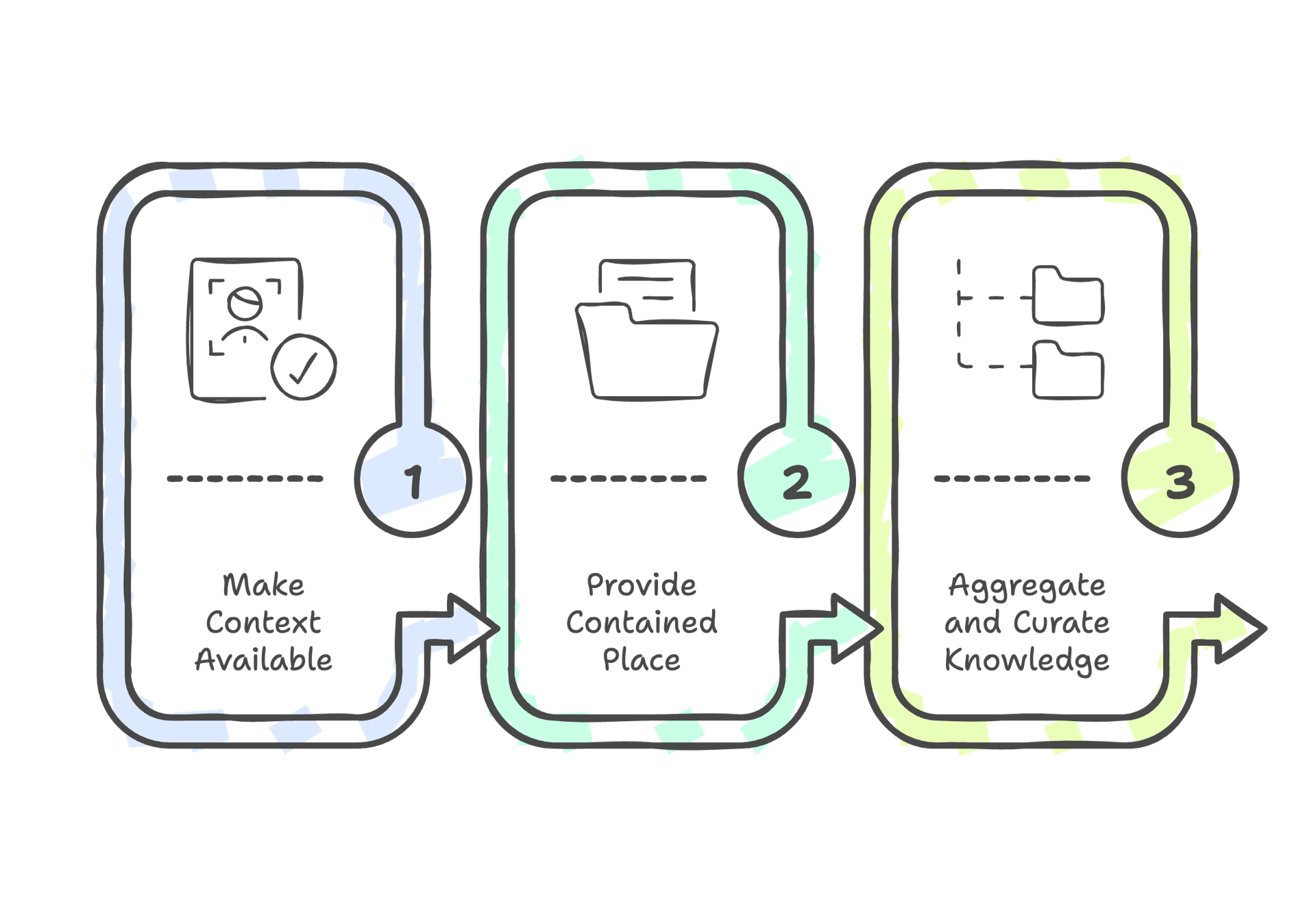
1. Make Context Available
AI can only work with what it can see. If key decisions, conversations, and artifacts live behind disconnected tools, AI will always operate with blind spots.
One useful principle is to stop treating tools as isolated vaults. You need to ensure they talk to one another.
How we do it: We use Rovo, our integrated AI platform, to unify knowledge across our entire stack. We liberally connect our tools so Rovo has access to the same sources a teammate would: documents in Confluence, work items in Jira, conversations in Slack, designs in Figma, and code in Bitbucket. Rovo uses Atlassian’s “Teamwork Graph” - a living map of how your people, content, and tools are actually connected - to understand the relationships between them.
The goal is fewer gaps.
2. Provide a Contained Place for Knowledge to be Aggregated
Context only becomes useful when it’s organized. Without structure, even well-connected knowledge turns into noise.
Many teams benefit from having a clearly defined place where related work comes together.
How we do it: We use Confluence spaces (dedicated home bases for specific teams or projects) as contained environments. Each space creates a clear hierarchy for goals, decisions, artifacts, and ongoing work. That containment helps both humans and AI understand what belongs together, what matters most, and how different pieces of work relate to one another.
3. Aggregate and Curate Knowledge Continuously
A system of record cannot rely on manual upkeep alone. Knowledge has to be created, updated, and connected as work happens.
This often means relying on automation and integrations rather than manual upkeep.
How we do it: We rely heavily on agents to do the “gardening” of our knowledge base. For example, we use a custom Rovo Agent that automatically synthesizes customer feedback. It pulls raw context from our Jira tickets and Slack bots, summarizes the themes, and populates a document in the relevant space.
We also use Loom AI recordings to generate meeting notes that immediately populate in the project space. Jira boards and Figma files are embedded directly into pages, so execution and decision-making context live alongside narrative knowledge. This reduces the burden on individuals while ensuring the system stays current and trustworthy.
Together, these practices turn scattered work into consolidated context. This is something AI can actually reason over.
The Shift That Actually Matters
A useful way to ground all of this is to ask a simple question:
Would a new hire succeed with the same context your AI has access to today?
If the answer is no, then it’s unreasonable to expect AI to behave like a fully ramped teammate.
As AI becomes more capable, the quality of organizational context matters more, not less. Knowledge management - often seen as a “nice to have” - arguably becomes one of the most important things for an organization to focus on.
Many organizations are beginning to recognize this shift. It’s prompting deeper thinking about how to lower the burden of aggregating and curating context over time.
The companies that succeed with AI will not be the ones purely chasing the latest model. They will be the ones that build a system of record for knowledge, so their digital teammates can actually think, reason, and act with purpose.